
How to Properly Maintain Your Commercial Truck Tires: A Complete Guide for Fleet Operators in the USA & Canada
Why Commercial Truck Tire Maintenance Matters More Than Ever
For fleet operators across the United States and Canada, tires represent one of the largest controllable operating expenses—second only to fuel. With commercial truck tires costing between $400 and $700 each, neglecting proper maintenance can quickly erode your profit margins .
The numbers tell a compelling story. Studies consistently show that underinflation by just 10 PSI can reduce tire life by 10% to 15% while cutting fuel economy by approximately 1% . For a fleet of 100 trucks averaging 50,000 miles annually, that translates to tens of thousands of dollars in unnecessary costs.
More critically, tire-related issues remain the second most common out-of-service violation during roadside inspections. In 2024 alone, underinflated or leaking tires resulted in over 120,000 out-of-service violations across North America .
Whether you’re running long-haul routes through the Canadian Rockies or regional delivery operations in Texas, a disciplined tire maintenance program protects your bottom line and keeps your drivers safe.
The Five Pillars of Commercial Tire Maintenance
1. Inflation Management: Your Highest-ROI Activity
Proper tire inflation is the single most impactful maintenance practice for extending tire life, improving fuel economy, and ensuring safety. The challenge? A tire can be 20% underinflated and still appear perfectly normal to visual inspection .
Key Inflation Best Practices:
- Check pressure cold—before the vehicle has been driven. Heat from driving can add 10-15 PSI to readings
- Use manufacturer load charts rather than applying a single fleet-wide pressure. Steer tires commonly run 100-120 PSI, while drive and trailer tires typically operate at 95-105 PSI depending on axle load
- Match dual tire pressures within 5 PSI—mismatched duals cause irregular wear and increase blowout risk
- Account for temperature changes—for every 10°F drop in ambient temperature, expect tire pressure to decrease by 1-2 PSI . This is particularly important for fleets operating across diverse North American climates
The Financial Impact:
For a 100-truck fleet averaging 50,000 miles per year at 6 MPG with fuel at $3.50/gallon, proper inflation management can deliver:
Total annual savings: Approximately $114,700
2. Tire Rotation: Even Wear for Maximum Lifespan
Different axle positions wear tires at dramatically different rates. Steer tires scrub during turns, drive tires absorb torque forces, and trailer tires endure lateral stresses through curves .
Rotation Schedule Guidelines:
- Long-haul operations: Every 50,000-60,000 miles
- Regional and urban delivery: Every 25,000-40,000 miles due to higher scrub rates
Missing rotation schedules can reduce tire lifespan by approximately 25%. For a fleet using 400 tires annually at $400 each, that represents $40,000 in premature replacements .
Critical Rotation Rules:
- Always use new tires on steer positions
- Move retired steer tires to drive positions—never the reverse
- Diagnose wear patterns before rotating to avoid masking underlying problems
- Track rotations with mileage-based alerts rather than calendar reminders
3. Wheel Alignment: The Invisible Tire Killer
A misalignment of just 1/16 inch toe causes a tire to drag sideways 8 feet for every mile driven. This relentless, invisible wear silently destroys tire investments and increases rolling resistance .
Alignment Schedule:
- Steer alignment check: Every 80,000-100,000 miles
- Full alignment: After any impact event (curb strike, pothole, accident)
- Pre-alignment inspection: Always verify tie rods, kingpins, and bushings before alignment—worn components mean adjustments won’t hold
Improper alignment can reduce tire life by up to 12,000 miles per set while increasing fuel consumption by 1-2% .
4. Wheel Balancing: Preventing Cupping Before It Starts
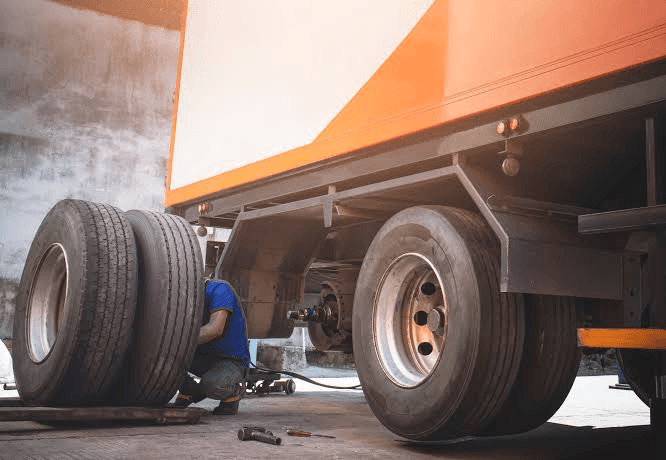
An out-of-balance wheel causes the tire to bounce at highway speeds, creating cupping—one of the most destructive and difficult-to-reverse wear patterns .
Balancing Best Practices:
- Balance at every tire installation and retread
- Rebalance immediately when drivers report highway-speed vibration
- Check wheel runout—a bent wheel may appear balanced but won’t roll true
Warning Sign: When drivers report a humming sound, cupping or irregular wear is likely becoming established. Early intervention can save the tire; delay means replacement.
5. Regular Inspections: Catching Problems Early
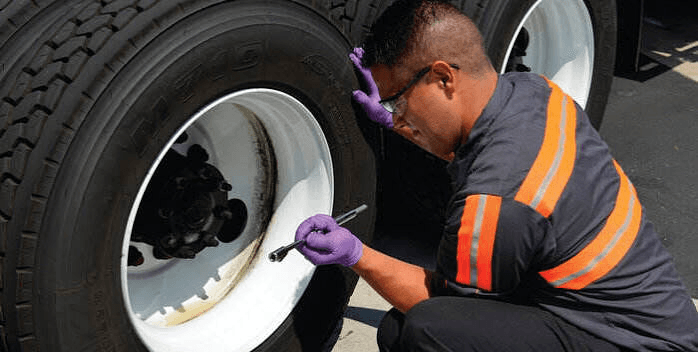
Routine inspections protect casing health, which is critical for retreading and maximizing tire investment. Tread depth checks with a simple gauge help drivers identify wear before it becomes dangerous .
Inspection Checklist:
- Tread depth: DOT requires 4/32″ for steer tires and 2/32″ for drive/trailer tires. Many fleets wisely pull steer tires at 5/32″-6/32″ for better wet-weather traction
- Visual damage: Look for cuts, bulges, embedded objects, and sidewall cracking
- Valve stems and rims: Check for leaks, cracks, or corrosion
- Irregular wear patterns: These diagnose underlying alignment, balance, or suspension issues
Understanding Tire Wear Patterns: What Your Tires Are Telling You
Every unusual wear pattern is a diagnostic message about underlying vehicle problems :
| Wear Pattern | Cause | Solution |
|---|---|---|
| Center wear | Overinflation | Reduce to spec pressure |
| Edge wear (both sides) | Underinflation | Increase pressure; check for leaks |
| One-side wear | Camber misalignment | Full alignment service |
| Cupping/scalloping | Worn shocks or imbalance | Replace shocks; rebalance |
| Feathering | Toe misalignment | Toe adjustment; alignment |
| Diagonal wear | Worn suspension bushings | Suspension service |
Beyond Basic Maintenance: Advanced Tire Management Strategies
Implement Tire Pressure Monitoring Systems (TPMS)
Modern TPMS technology provides real-time pressure and temperature alerts, catching slow leaks before they become roadside emergencies. ROI payback typically occurs in under two months for critical assets .
Track Tire Lifecycle Data
Every commercial tire passes through distinct lifecycle stages. The retread decision window—typically at 8/32″ remaining tread—represents the highest-ROI moment in a tire’s life. Missing this window by 25,000 miles often means casing failure before retreading is possible .
Fleets that capture retread opportunities at 60-70% of eligible tires recover $60,000-$90,000 annually on a 300-tire drive position fleet .
Train Your Drivers
Driver behavior significantly impacts tire life. Speeding, hard braking, curbing, and tight turns accelerate wear. A 30-minute pre-trip inspection that catches a slow leak saves hours of roadside downtime .
Why Thailand Truck Tires for Your USA & Canada Operations
At Thailand Truck Tires, we understand the unique demands of North American fleet operations. Our commercial truck tires are engineered to meet the rigorous standards required for USA and Canada highways, from I-95 corridor traffic to Canadian winter conditions.
What Sets Us Apart:
ISO-Certified Quality
Our manufacturing partners hold ISO9001, TS16949, and ISO14001 certifications—the same automotive quality systems used in Europe and Japan . Every tire meets or exceeds DOT requirements for North American roads.
Direct-from-Thailand Pricing
Thailand is the world’s largest producer of natural rubber, meaning compound supply sits next to the factory. This proximity to raw materials delivers cost savings we pass directly to USA and Canada fleet operators—often undercutting equivalent EU or North American manufactured patterns.
Complete TBR Range
We supply steer, drive, and trailer patterns in the sizes North American fleets demand most:
- 11R22.5, 11R24.5
- 295/75R22.5, 285/75R22.5
- 12R22.5, 315/80R22.5
- 385/65R22.5, 425/65R22.5
Premium and Value Brands
We’re brand-agnostic because different applications require different solutions:
- Premium: Michelin, Bridgestone, Continental, Pirelli, Yokohama
- Value-performance: Double Coin, Triangle, Kumho, Alliance
Reliable North American Shipping
We ship FCL, LCL, and RoRo to all major USA and Canada ports with realistic production windows and confirmed DOT week codes before loading. Mixed-brand and mixed-size containers are accepted—ideal for dealers testing new patterns.
The Bottom Line: Tire Maintenance Protects Your Fleet’s Future
Effective commercial truck tire maintenance isn’t just about avoiding blowouts—it’s a systematic approach to controlling your second-largest operating expense. Fleets that implement disciplined pressure management, rotation schedules, alignment checks, and retread capture programs consistently achieve 20-30% reductions in annual tire spend .
When you’re ready to source high-quality commercial truck tires at competitive wholesale prices, Thailand Truck Tires delivers the quality, consistency, and value that USA and Canada fleet operators depend on.
Ready to optimize your tire program?
Request a wholesale quote today. Tell us your sizes, quantities, application requirements, and destination port—we’ll respond with pricing, availability, and realistic shipping dates.